24/7 Live Law Session With Experts ✦ Exclusive Offer: 50% OFF – Ends in 2 Days!
The Best Evidence in Family Court: Insights from Al Noor Law Firm
Building a Strong Case with the Right Evidence
Very strong evidence is required by a family court to prove any claims regarding children for custody or visitation, divorce, or financial claims. You need to know what constitutes the best evidence since it is critical to safeguarding your rights and having the outcomes you prefer. AL Noor Law Firm links you with nearby well-experienced family lawyers who can advise you on how to collect that evidence and present it to the court.
Why Evidence Matters
Strong, well-organized evidence is essential for success in family court. Keeping accurate documents, records, and communications helps support your claims, speeds up legal proceedings, and improves your chances of a fair outcome.

Importance of Evidence in Family Court
Because courts largely rely on facts and evidence in their decisions, even genuine claims can be dismissed without this support. Role of strong evidence in determining credibility and legitimacy, and authority in deciding custody, support, and property issues to be enforced if one parent is approved competent to care for and provide for the child during divorce proceedings. Family lawyers near me know how to organize and present evidence in accordance with legal standards.
Why Evidence Requirements Differ Between Khula, Divorce, and Maintenance Cases
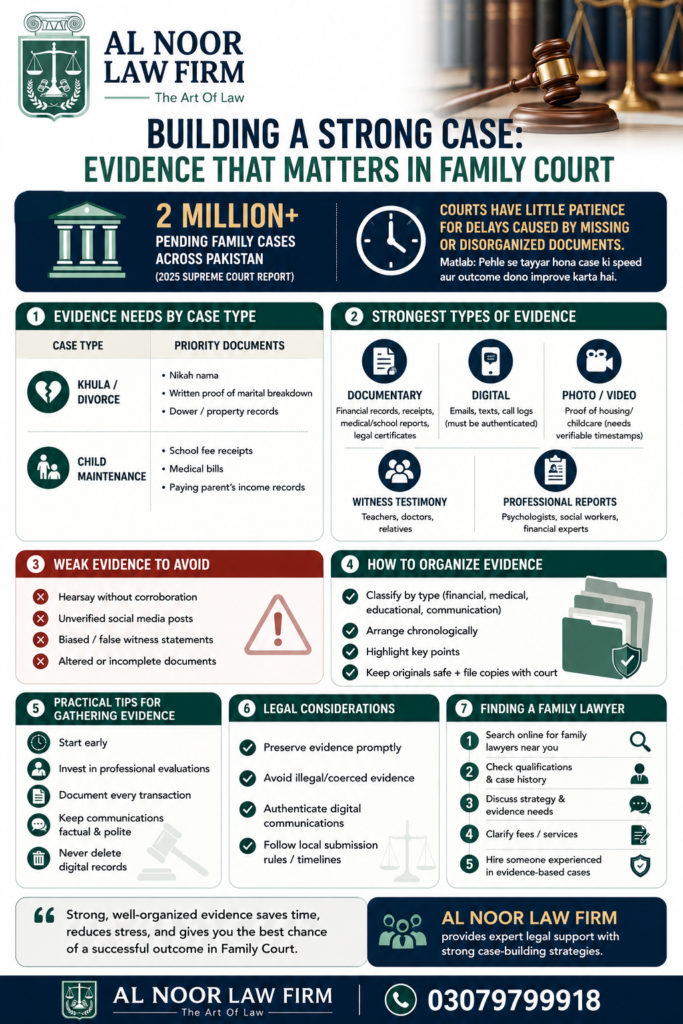
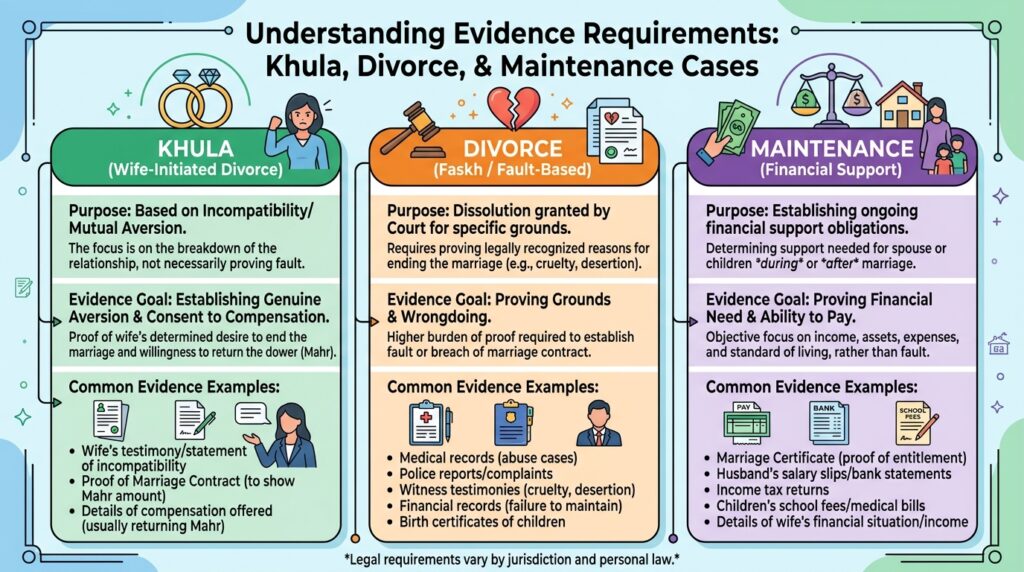
One point worth adding to the evidence categories above is that the strongest documents to gather actually depend on which type of family matter you are dealing with, since a khula case and a maintenance claim rarely rely on the same paperwork. Pakistan’s family courts are already working through a heavy backlog, and a 2025 Supreme Court report placed the number of pending cases across the country at more than two million, which means judges have little patience for hearings that get bogged down while a party scrambles to locate a document that should have been ready from the start. For someone pursuing a khula or divorce case, the priority documents are usually the nikah nama, any written communication showing the breakdown of the marriage, and records related to dower or property, since these establish the marital relationship and the grounds being argued far more directly than a general witness statement ever could. A maintenance case built around a child’s needs looks completely different at the evidence stage. Here, school fee receipts, medical bills, and a clear record of the paying parent’s income matter far more than communication logs, because the court is trying to fix a specific monthly figure rather than decide whether the marriage should end, and vague claims about a father’s earnings rarely hold up against his actual pay records or business filings. Anyone preparing for a child maintenance case should start collecting these financial documents well before filing, since asking the other parent to voluntarily disclose income later in the process is rarely realistic. Recognizing this difference early, rather than gathering the same generic file for every type of family matter, saves real time once the case actually reaches a judge.

Evidence Types Considered as the Strongest
Some evidence is given more weight in family court:
Documentary Evidence
These are tangible proofs. It includes:
Financial statements and records
Receipts of child-related expenditures
Medical and school reports
Legal documents like Marriage and Custody Certificates and Contracts
Digital Evidence
This term refers to email messages, text messages, or call logs that provide evidence of the parties’ communication and agreements. Such evidence must be properly retained and authenticated first before a court can accept it.

Photographic and Video Evidence
Photos and videos can prove the appropriate housing conditions, childcare, or the actual situation or progress in the case in dispute. Please ensure they have verifiable timestamps and authentication.
Witness Testimony
Credible witnesses who can provide testimony include teachers, doctors, or even relatives who support the allegation. It will be the standing of those in the court that decides the relevance of such testimonies.
Professional Reports:
The credibility of such evaluations used in custody or financial cases is reinforced by psychologists, social workers, or financial experts, whose work must be thorough and objective, prepared by licensed professionals.
Avoid Weak Evidence
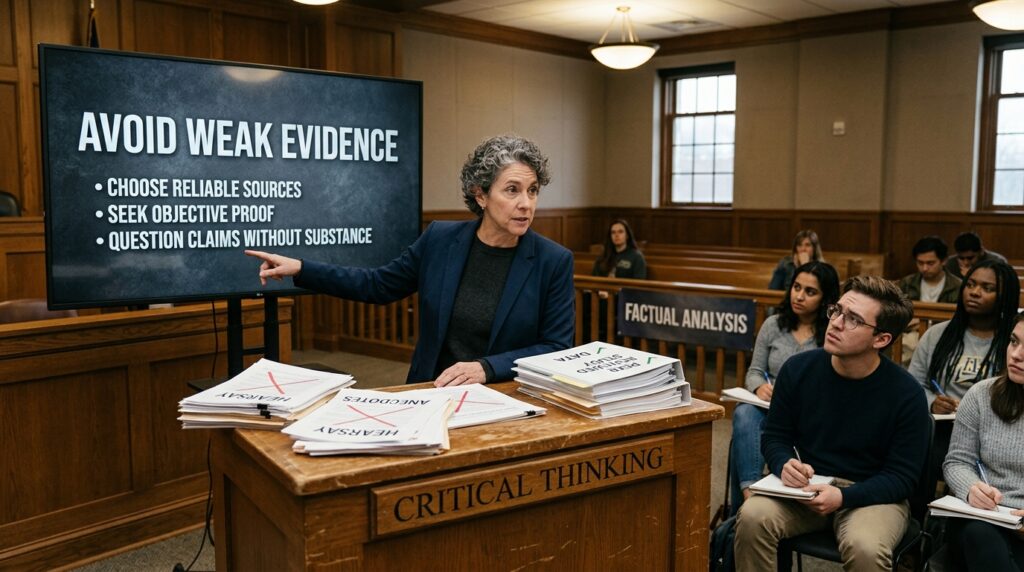
Less convincing or inadmissible are:
hearsay without corroboration
nonvalidated social media postings
biased or false witness statements
altered or incomplete documents
Family lawyers near me ensure that evidence meets legal standards and is presented effectively to avoid rejection.
Organizing Your Evidence
Well-organized evidence makes things credible and efficient:
Classify evidence according to types: financial, medical, educational, and communication
Arrange in chronological order
Emphasizing the most important points will also make it easier to fish out information.
In the originals stored with copies filed with a court when needed, a clear, organized method would give judges a clear understanding of your case, reducing misunderstandings.
Practical Tips for Gathering Evidence
Start early so nothing is left to the last minute.
Spend the money on professional services for financial or psychological evaluations.
Document every transaction regarding custody or support.
All communications between both parties must be factual and polite.
Never delete digital communications, as some courts generally disapprove of this practice.

Legal Considerations
Promptly preserving evidence is paramount for determining its admissibility and the strength of the case.
Try not to touch the illegal or coerced evidence concerning admissibility.
Whenever possible, do authenticate your digital communications.
Observe local submission-related rules for timelines and formats.
Consulting a family lawyer near me for advice on complying with court procedures is advisable.
Practical Example
While seeking primary custody of her child, this mother documented school performance, medical visits, and extracurricular activities. She maintained texts indicating the father’s cooperation. The evidence was organized with the help of nearby family lawyers, and she presented it well in court. The well-organized documentation was one of the factors that led the judge to award her primary custody.

Finding a Good Family Lawyer
Strong evidence gives you a better chance:
Look for family lawyers near you online.
Check for qualifications, experience, and case history.
Arrange a meeting to discuss strategies and evidence needs.
Clarify fees and services.
Hire a lawyer who has experience in handling evidence and in family court cases.
Additional Resources
Family court guidelines by the government.
FindLaw Family Law Resources.
AL Noor Law Firm service pages for legal consultations and representation.