24/7 Live Law Session With Experts ✦ Exclusive Offer: 50% OFF – Ends in 2 Days!
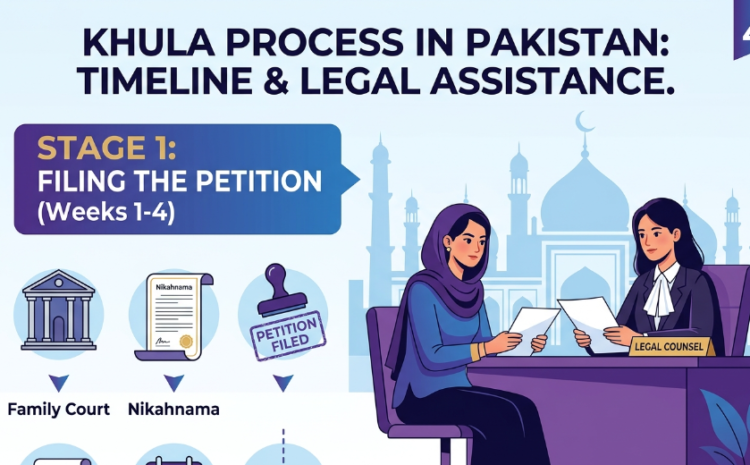
Khula Process in Pakistan: Timeline and Legal Assistance
Step-by-Step Procedure: From Filing to Final Decree
To end a marriage involves a complicated procedure, both emotionally and legally, and thus, women often inquire how long the Khula process takes in Pakistan. Knowing time helps to develop expectations that would aid planning and management. This guide covers the primary steps involved, the factors influencing them, and how a khula lawyer in Karachi could ease and speed them.
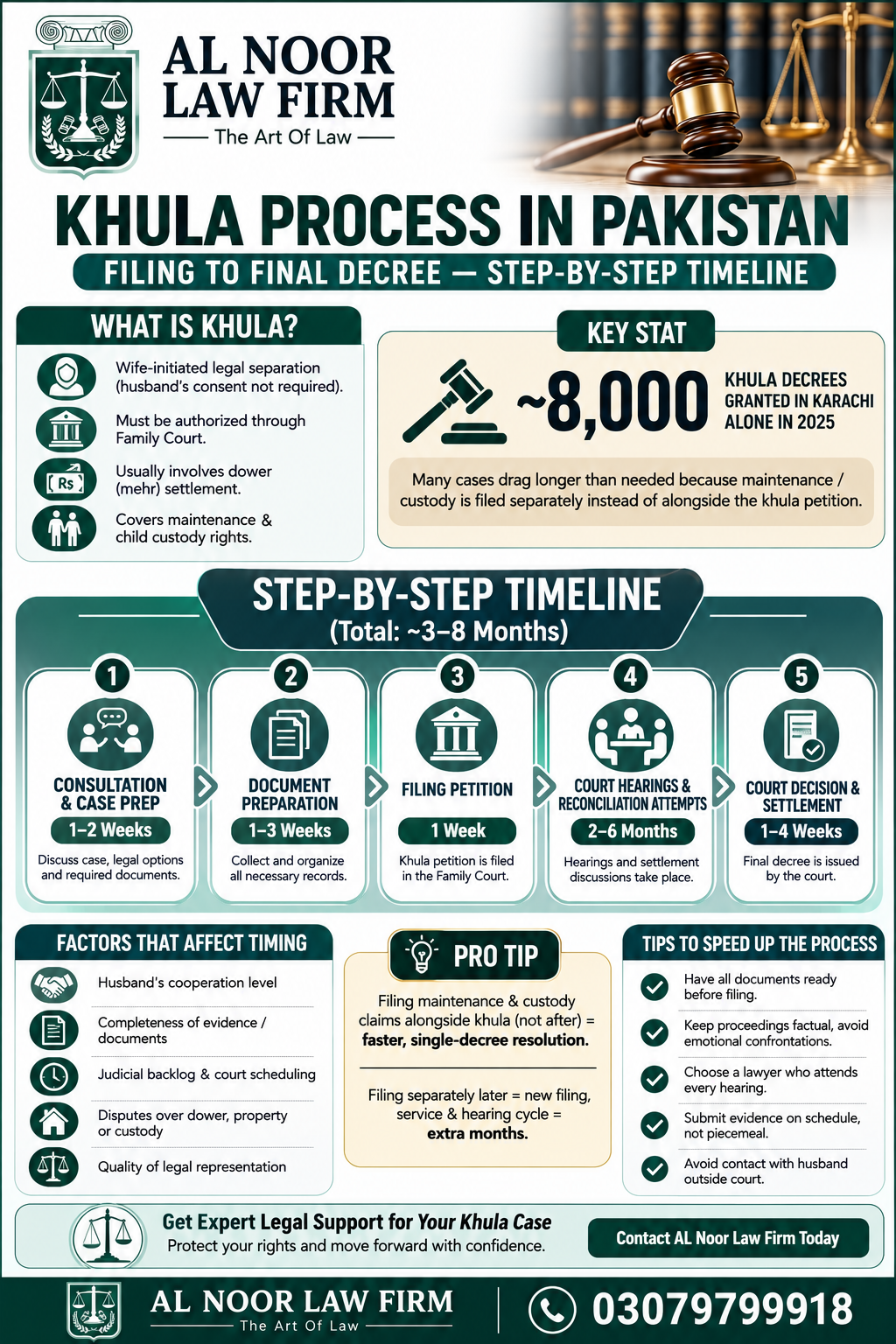
Khula Process in Pakistan
Step-by-Step Legal Timeline
The Khula process in Pakistan usually takes 3–8 months, depending on court schedules, case complexity, and document readiness. Filing complete documents and choosing an experienced family lawyer can help avoid delays and ensure a smoother legal process.
What is Khula, and how does it work?
Khula is one of the legal procedures through which a wife willingly detaches herself from her husband, unlike strike, where the husband is required to accept the conjecture initiated from the wife’s side. In Pakistan-the process of khula should be authorized from the Family Court. Some features are:
Legal action instituted at the behest of the wife
A mandatorily process through Court
Generally involved with the settlement of dower (mehr)
For a provision and rights of maintenance and custody of children.
Engaging a khula lawyer in Karachi will ensure conforming your petition to legal standards, reducing the time frame, and protecting your rights.
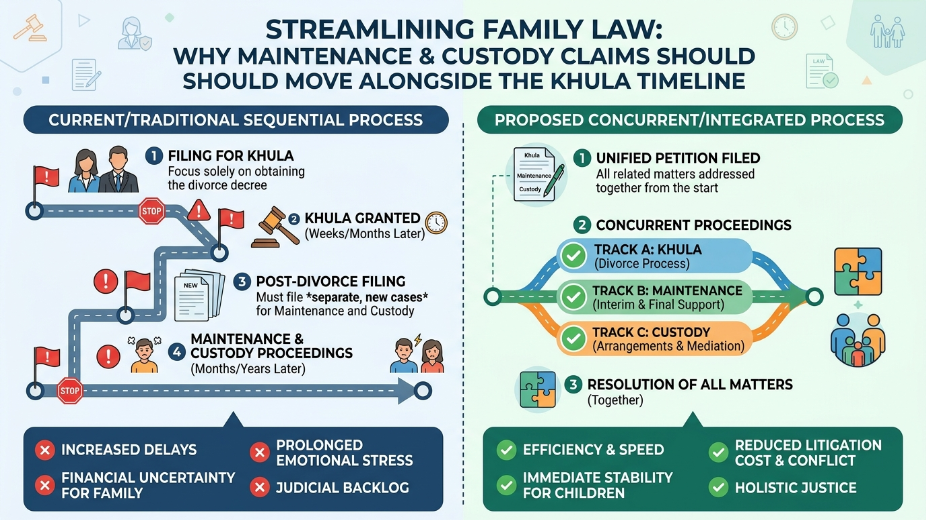
Why Maintenance and Custody Claims Should Move Alongside the Khula Timeline
One thing this timeline does not make obvious enough is that the three-to-eight-month window described above covers the dissolution of the marriage itself, not necessarily every financial and parental matter tied to it. Family lawyers tracking Karachi’s courts report that the city saw roughly eight thousand khula decrees granted in 2025 alone, and a large share of those cases ran longer than necessary simply because maintenance and custody were treated as an afterthought rather than being raised at the same time as the main petition. Waiting until after the khula decree to file a separate application for support or custody adds an entirely new filing, service, and hearing cycle on top of the months already spent on the marriage dissolution itself, which is exactly the kind of avoidable delay this guide warns against elsewhere. A wife who raises her maintenance claim alongside the khula petition, rather than as a follow-up matter, allows the same judge to hear both issues together, which tends to produce a faster and more consistent outcome than running two separate proceedings back to back. The same logic holds for children. Custody arrangements and ongoing support are often the most contested part of the entire case, and pursuing a child maintenance claim from the outset, supported by clear documentation of the children’s actual expenses, gives the court everything it needs to settle the matter in the same decree rather than sending the family back through another round of hearings months later. A khula lawyer who plans the case this way from the first consultation, rather than treating each issue separately, is usually the difference between wrapping everything up within that three-to-eight-month range and watching the case stretch on well past a year.
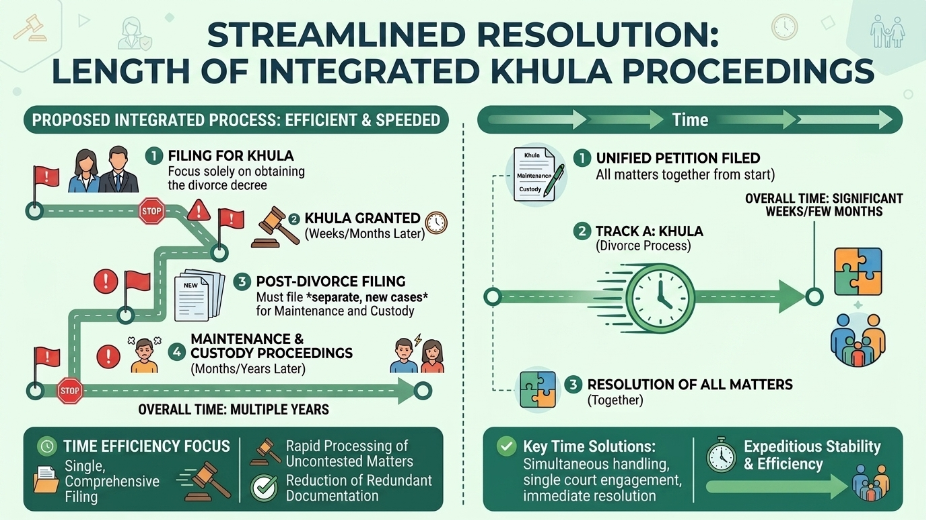
Length of Khula Proceedings:
Khula is in fact so different in duration depending on intricacies of the case, court schedules, and cooperation from both spouses. Basically, it entails:
Consultation and case-preparation (1-2 Weeks)
Meeting with lawyer, gathering documents, talking about grounds possessed for Khula.
Document Preparation (1-3 Weeks)
Collecting marriage certificates, CNICs, witness affidavits, proof of residence, and evidentiary documents supporting your petition.
Filing Petition (1 Week)
The petition was filed in Family Court regarding Karachi. The khula lawyer in Karachi saw to it that there were no discrepancies or lapses.
Court Hearings and Psyops Attempts of Reconciliation (2-6 Months)
Reconciliation is a must. Both spouses and their witnesses will have their statements presented during the hearings. If the husband is stubborn or if some evidence must be verified, the proceedings may delay further.
Court Decision Settlement (1-4 Weeks from Final Hearing):
Khula has been awarded; the court will decide the dower settlement and/or custody of children and maintenance.
With complication in the case issues with court functioning, the Khula process in Pakistan generally takes around 3-8 months. Simple cases with the same level of cooperation can be completed relatively more quickly.

Factors Affecting Diu Timing
There are clear signs of the likelihood or unlikelihood of cooperation from the, husband.
Completeness of evidence and documents
Judicial backlog and scheduling
Controversies about dower, marriage property, or custody

Quality of legal representation and preparation
A khula lawyer in Karachi minimises delay through thorough document preparation, effective representation, and pertinent advice:
Ways to Speed up the Khula Process
All that is required must be fully ready before filing the case since it will draw easy references.
Do not bring the husband to an emotionally charged situation for the judge to witness. The husband should hear clearly stated facts, with no emotional undercurrents.
From many complaints about delays, it has been found that the lawyer did not appear at hearings. One good thing is to assign a lawyer who attended every hearing.
Evidence should not be submitted piecemeal into court; it should be submitted continuously according to timetable.
Never confront the husband outside the court.
These will even more improve efficiency and eliminate avoidable delays in court proceedings.